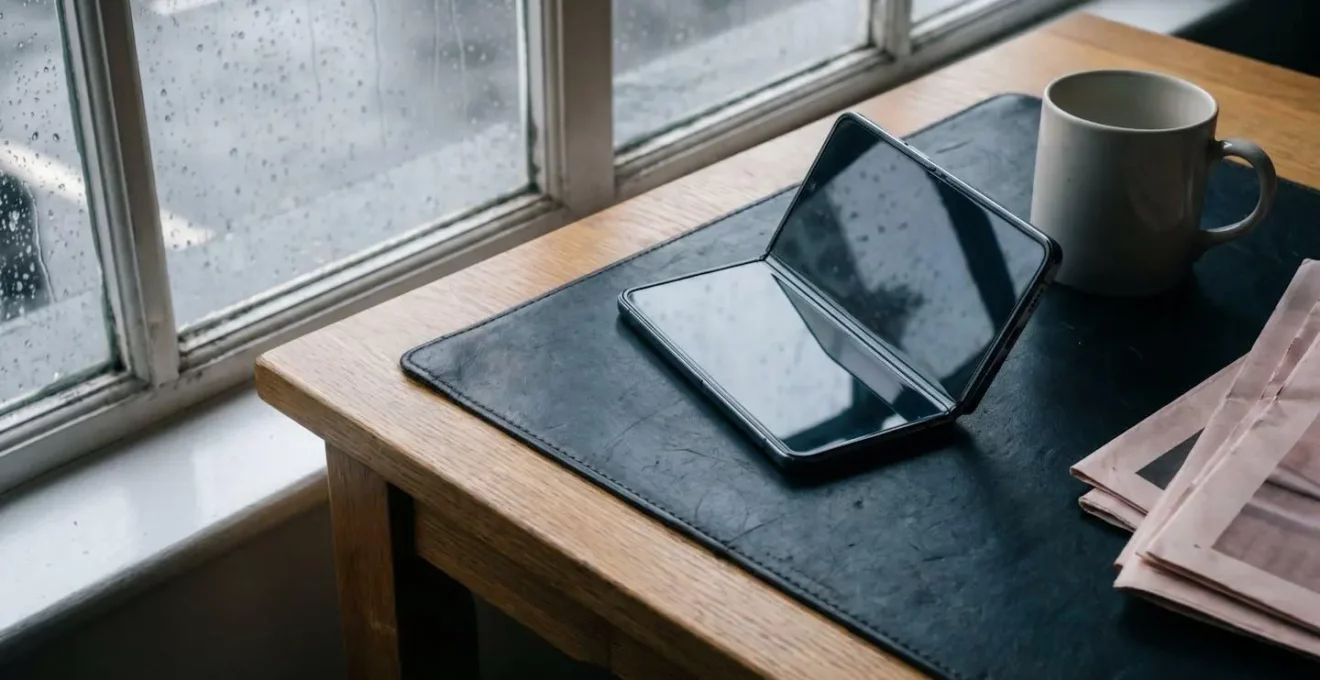
Despite marketing claims, the real-world reliability of foldable phones hinges on their hidden mechanical weaknesses, not just their impressive specs.
- The screen crease is a permanent sign of material fatigue, while microscopic pocket debris poses a catastrophic threat to the intricate hinge mechanism.
- The high cost and low availability of repairs in the UK create a significant ownership risk, often outweighing the benefits of multitasking for many users.
Recommendation: Do not buy a foldable until you understand its specific failure points and can honestly assess if the usability reward justifies the high financial and durability risk.
For years, the promise of a phone that unfolds into a tablet has hovered on the tech horizon, a tantalizing glimpse of the future. As an early adopter in the UK, you’ve likely watched the evolution, wondering if now is the time to finally take the plunge. Mainstream advice often says the technology is “maturing” and that you “get used to” the quirks like the screen crease. But after extensive long-term testing, I can tell you that this conversation misses the point entirely. The real question isn’t whether they’re getting ‘better’, but whether they’ve overcome the fundamental laws of physics that work against them every time you open and close the device.
This isn’t a review of specs or camera quality. This is a brutally honest, durability-focused assessment based on seeing these devices live and die in the real world. We’ll move beyond the marketing gloss to dissect the material science of the crease, the mechanical vulnerability of the hinge, and the harsh financial reality of repairs in the UK. The goal is to arm you with a deep, mechanical understanding of these devices, so you can decide for yourself if the undeniable magic of a foldable screen is worth the inherent risks. This is about understanding the specific failure points before you invest a significant amount of money.
To help you navigate this complex topic, we have structured this analysis to address the most critical durability and usability questions that tech enthusiasts are asking. Here is a look at what we’ll cover.
Summary: The Real-World UK Durability Test for Foldable Phones
- Why Does the Screen Crease Become More Visible After 6 Months of Use?
- How to Apply Screen Protectors on Foldables Without Creating Bubbles?
- Galaxy Z Fold or Pixel Fold: Which Multitasks Better for Business Users?
- The Pocket Debris Mistake That Destroys Foldable Hinges Within a Year
- When to Adopt Foldables: The Durability Milestone That Signals Mainstream Ready?
- When to Choose Repairability Over Specs for a 5-Year Device Lifespan?
- LTPO or Fixed High-Refresh: Which Display Tech Handles Battery Better?
- How to Choose Tech That Genuinely Reduces Your Carbon Footprint?
Why Does the Screen Crease Become More Visible After 6 Months of Use?
The screen crease is the most visible compromise of a foldable phone, and its tendency to deepen over time is not your imagination. It’s a direct result of material fatigue. Unlike the rigid glass on a standard smartphone, a foldable display is made of more malleable materials. In fact, foldable phones utilize plastic polymer or ultra-thin glass that shows permanent marks over time due to repeated stress at the fold point. Every time you open and close your device, you are bending and unbending a complex sandwich of materials that were never designed to be perfectly flat again.
Think of it like folding a piece of paper. The first fold is sharp. The hundredth fold is soft, worn, and permanently weakened. The Ultra-Thin Glass (UTG) is the same. While incredibly impressive as a feat of engineering, it is still glass, and it is being subjected to stress cycles it was never meant to endure in a traditional form factor. The initial, barely-there crease you see on day one is the starting point. After six months of daily use—hundreds, if not thousands of folds—the material itself begins to deform on a microscopic level. This deformation catches light differently, making the crease appear deeper and more pronounced, especially in off-axis viewing.
While the visual is one thing, the tactile feel also changes. The initial smoothness gives way to a more noticeable dip. However, many long-term users find their perception changes. As the Android Central editorial team noted in their analysis, the user experience can normalise this flaw.
The crease becomes sort of unnoticeable. It’s still there, and you still see and feel it, but you stop caring about it because the display still looks good in that spot, and it’s just as touch-sensitive as anywhere else on the screen.
– Android Central editorial team, Android Central analysis on foldable screen perception
Ultimately, the increasing visibility of the crease is a physical inevitability. It’s a trade-off between form factor and material integrity. While manufacturers are working on “waterdrop” hinges and other mechanisms to reduce the sharpness of the fold, the fundamental challenge of bending a screen remains. Accepting this degradation is a core part of the price of admission for current-generation foldable technology.
How to Apply Screen Protectors on Foldables Without Creating Bubbles?
Applying a screen protector to a flat phone is frustrating; applying one to a foldable feels like performing microsurgery. The flexible screen is soft and prone to damage, and the central crease is a magnet for bubbles and adhesion failure. Unlike standard phones where you might get away with a few specks of dust, the tolerances on a foldable are much tighter. A single rogue particle can create a bubble that, when folded, creates a pressure point that could damage the delicate display underneath.
The pre-installed screen protectors are a vital part of the display’s structure and should not be removed casually. However, they do wear out, scratch, and eventually start to peel. When this happens, replacing it is a high-stakes operation. A botched application not only looks terrible but can compromise the screen. For those brave enough to attempt a DIY replacement, adopting a professional technique is essential to minimize the risk of a costly mistake. The key is controlling the environment and your technique, focusing on eliminating dust and applying pressure correctly around the hinge.
Given the difficulty and risk, many owners in the UK are wisely opting for a professional service. It’s a small price to pay for peace of mind, especially when a replacement screen can cost hundreds of pounds. For those determined to do it themselves, following a meticulous process is the only way to succeed.
Your Action Plan: Professional Foldable Screen Protector Installation
- Atmosphere Control: Apply the protector in a steamy bathroom right after a hot shower. The steam helps weigh down dust particles, creating a cleaner working environment and reducing static.
- Clear the Area: Remove the phone’s case completely. This prevents the edges of the case from interfering with the alignment or lifting the protector’s corners during application.
- Master the Hinge-First Method: For foldables, start the application from the hinge and work outwards. This contrasts with the edge-first method for flat screens and is crucial for managing the crease.
- Crease Accommodation: As you apply, ensure the protective film is properly seated into the crease area. Don’t stretch the film; allow it to naturally conform to the dip to prevent future bubbles or lifting.
- Verify with an Expert: If in doubt, seek out technicians trained specifically on foldable devices. Their experience is invaluable for a perfect, long-lasting application.
If the thought of this process fills you with dread, you’re not alone. The simple fact is that these devices are not designed for easy user maintenance. In many UK cities, professional application at Samsung Experience Stores typically costing £20-£30 is a far more sensible investment than risking a DIY disaster. This cost underscores the higher total cost of ownership for foldables.
Galaxy Z Fold or Pixel Fold: Which Multitasks Better for Business Users?
For the UK business user, the appeal of a foldable is clear: it’s the promise of a phone in your pocket that becomes a powerful multitasking tablet on the go. Answering emails on a cramped train to London Paddington or reviewing a spreadsheet while grabbing a coffee becomes a genuinely better experience. Both the Samsung Galaxy Z Fold and Google Pixel Fold are champions of this new form factor, but they approach the multitasking philosophy from slightly different angles, forcing users to make a crucial choice based on their workflow.
The Galaxy Z Fold has long been the standard-bearer, with its mature software, robust multi-window management, and taskbar making it feel like a miniature desktop. Its support for the S-Pen (sold separately) is a game-changer for anyone who needs to sign documents or take precise notes. The Pixel Fold, by contrast, leverages Google’s software prowess for a cleaner, more intuitive experience that feels deeply integrated with the Android OS. It’s less about cramming features in and more about making the ones that are there feel seamless.
The physical hardware also dictates the user experience. The choice between the Z Fold’s taller, narrower cover screen and the Pixel Fold’s wider, more traditional smartphone-like front display is a daily usability decision. Do you want a better one-handed phone experience (Pixel) or a cover screen that’s better for scrolling feeds (Galaxy)? These are the real-world trade-offs that a spec sheet can’t fully convey. The following comparison highlights the forward-looking differences based on the current trajectories of both model lines.
| Feature | Samsung Galaxy Z Fold 7 | Google Pixel 10 Pro Fold |
|---|---|---|
| Weight | 215g (significantly lighter) | 258g (heavier) |
| Screen Crease | Much less noticeable | More visible crease |
| Cover Display | 6.5-inch, usable aspect ratio | 6.4-inch, slightly cramped |
| Processor | Snapdragon 8 Elite (faster) | Tensor G5 (AI-focused) |
| Durability Rating | IP48 (dust resistant) | IP68 (superior water/dust) |
| Stylus Support | S-Pen compatible (sold separately) | Limited stylus support |
As the table shows, the decision is a complex one. A future Galaxy Z Fold prioritises raw power, a lighter chassis, and dedicated stylus support, making it a power user’s dream. The future Pixel Fold, however, could win on software smarts, a more comfortable-to-hold design, and superior durability with a potential IP68 rating, which signifies it’s fully dust-tight and can handle deeper water immersion. For business users, the choice isn’t about which is “better,” but which set of compromises and strengths aligns with their specific mobile work style.
The Pocket Debris Mistake That Destroys Foldable Hinges Within a Year
Manufacturers love to talk about hinge durability in terms of folding cycles. You’ll often see figures suggesting hinges are tested to withstand 200,000+ folds translating to approximately 5 years of daily use at 100 folds per day. This sounds reassuring, but it’s a lab-based metric that completely ignores a foldable’s true kryptonite: the real world. The single biggest threat to your expensive foldable isn’t dropping it; it’s the invisible enemy lurking in your pocket or bag.
The hinge mechanism, for all its complexity, is a mechanical system with incredibly tight tolerances. While modern foldables include tiny brushes designed to sweep debris out, they are no match for the fine, abrasive particles common in everyday life. Pocket lint, grains of sand, makeup powder, and other microscopic debris can and will find their way into the hinge cavity. Once inside, this debris doesn’t just sit there; it gets ground between moving metal parts every time you open and close the phone, acting like liquid sandpaper on the delicate internal components.
UK Repair Shop Insight: The “Gritty Hinge” Failure
UK repair technicians consistently identify a primary cause of hinge failure that is particularly prevalent in the UK environment. Fine, damp grit—whether it’s beach sand from a trip to Cornwall, hiking debris from the Peak District, or even lint from the pocket of a classic Barbour jacket—works its way into the hinge’s tight tolerances. Unlike dry dust, this gritty paste doesn’t get swept out by the internal brushes. Instead, it causes a distinctive grinding sound and feel. Technicians report that users who ignore this and continue to force the hinge open or closed are the ones who transform a potential cleaning issue into catastrophic inner screen damage, as the pressure from the jammed hinge cracks the display from behind.
This “pocket debris mistake” is so destructive because it’s a gradual process. You might first notice a slight crunching sound or a feeling that the hinge isn’t as smooth as it used to be. The temptation is to ignore it or try to force it past the sticking point. This is the worst thing you can do. That resistance is a physical blockage, and applying force transfers that stress directly to the most fragile part of the entire device: the ultra-thin glass of the inner display. Many “spontaneous” screen failures are actually the delayed result of a compromised hinge. Treating your foldable like a delicate instrument, and ensuring your pockets are clean before putting it away, is not just advice—it’s a critical preventative measure.
When to Adopt Foldables: The Durability Milestone That Signals Mainstream Ready?
For all the buzz and media attention, it’s crucial to ground ourselves in reality. Despite a significant rise in adoption, current ownership of foldable smartphones accounts for just 1% of total smartphones owned across the UK. This isn’t a market on the cusp of exploding; it’s a niche, albeit a growing and fascinating one. The primary barrier to mass adoption isn’t price or features—it’s the lingering, pervasive question of durability.
So, when will it be the right time for the average consumer to jump in? The answer lies in waiting for a clear “Durability Milestone.” This won’t be a single event, but a convergence of technological advancements that signal the form factor has moved from “early adopter risk” to “mainstream reliable.” This milestone has several key components. First is a genuine, certified resistance to dust. An IP rating that includes dust protection (e.g., IP5X or IP6X) would be the single biggest indicator that hinge ingress issues have been solved at an engineering level. Second is a significant leap in screen hardness, moving the needle from “scratches with a fingernail” to something approaching the resilience of traditional smartphone glass.
Finally, and perhaps most importantly for consumer confidence, is the decentralisation of repair. When you can walk into a high-street shop in Manchester or Bristol and get a foldable screen replaced in an hour, the same way you can with an iPhone today, the fear of a catastrophic failure will be significantly diminished. As one industry expert observes, the market has a long way to go to overcome this initial hesitancy.
The Foldable market has ample room for growth, and as more people buy, fewer will feel the first-move anxiety associated with adopting a new technology. However, it remains to be seen whether Foldables can move from a niche technology toward mass adoption.
– Jack Hamlin, Global Consumer Insights director at Worldpanel Division, Kantar
Until these milestones are met, buying a foldable remains a conscious decision to be a part of a public beta test. The technology is exciting, the form factor is revolutionary, but the risks are real and tangible. The “right time” to adopt will be when the conversation shifts from “be careful with it” to “it just works.” We are not there yet.
When to Choose Repairability Over Specs for a 5-Year Device Lifespan?
In the world of standard flagship phones, the debate is often about specs: which has the faster processor, the better camera, the brighter screen? But when considering a foldable, a device you might hope to use for three, four, or even five years, this conversation is dangerously incomplete. The single most important “spec” for long-term foldable ownership isn’t on the marketing materials—it’s repairability. The intricate, delicate, and tightly-packed nature of these devices makes them a nightmare to fix.
The extreme complexity of a foldable’s internal structure is a marvel of engineering, but it’s also its Achilles’ heel when it comes to repairs. These aren’t devices that can be easily serviced by a local corner shop. They require specialized tools, trained technicians, and a dust-free environment simply to open them without causing further damage. This reality creates a massive “Repairability Deficit” compared to conventional phones.
The UK’s Foldable Repair Accessibility Gap
The repair landscape in the UK reveals a stark disparity. While iPhone screen repairs are a commodity, available at countless high-street locations, foldable repairs are centralized, sparse, and often require mailing your device away for weeks. The reason is the complexity. Technicians must be specifically trained on Galaxy Z Fold or Pixel Fold mechanisms. The ultra-thin displays can tear with the slightest mishandling during removal. Hinge replacements demand precise calibration to maintain fold angles and screen tension, a process so complex that it often involves replacing the entire chassis assembly, dramatically increasing the cost.
This repair deficit has a direct and painful financial consequence. Out of warranty, you are facing a truly eye-watering bill. For example, the cost of the part alone for a new inner screen can be astronomical, with some out-of-warranty screen replacements reaching £800-£900+ for the Pixel Fold inner screen part cost alone. That’s the price of a brand-new flagship phone. When a single component failure can cost as much as a new device, the initial purchase price is only the beginning of the potential investment. For anyone planning to keep a device for 5 years, prioritizing a model with a better repair network, more accessible parts, and a lower out-of-warranty cost is a far more rational decision than chasing the absolute highest specs.
LTPO or Fixed High-Refresh: Which Display Tech Handles Battery Better?
Living with a foldable means managing two very different battery life scenarios: the efficient, small-screen “phone mode” and the power-hungry, large-screen “tablet mode.” Squeezing a full day of heavy use out of a battery that has to power an 8-inch screen is a huge challenge for manufacturers. A key weapon in this fight is the display’s refresh rate technology, and the battle is largely between two approaches: LTPO and a fixed high refresh rate.
A fixed high-refresh rate screen, say at 120Hz, is smooth and fluid, but it’s a blunt instrument. It redraws the screen 120 times every second, whether you’re scrolling rapidly through a social feed or staring at a static email. This wastes a significant amount of power. LTPO (Low-Temperature Polycrystalline Oxide) is the smarter solution. It’s a type of display backplane that allows for a dynamic, variable refresh rate. It can ramp up to a silky-smooth 120Hz when you’re gaming or scrolling, but critically, it can also drop down to as low as 1Hz when you’re looking at a static photo or using an always-on display. This ability to match the refresh rate to the content on screen is the single most important technology for preserving battery life on a large-screened device.
For a foldable, this is not just a nice-to-have; it’s essential. When you’re using the large inner display for reading, writing, or watching media, an LTPO panel can intelligently lower its power consumption, stretching the battery life significantly. Without it, the large, vibrant screen would drain the battery at an alarming rate. Even with this technology, heavy use can push the limits of current battery capacities. For instance, real-world UK usage testing shows the Z Fold 7’s 4400mAh cell drains to 10% by nighttime on busy days, with more casual use patterns ending at around 30-40% remaining. This demonstrates that while LTPO is a crucial tool, it’s not a magic bullet. Users must still be mindful of their usage, especially when relying heavily on the inner display.
When comparing foldable devices, always look for LTPO technology on the spec sheet. A device with a fixed high-refresh rate on its main display is making a major compromise on battery efficiency that you will feel every single day. It’s a clear signal that cost-cutting has taken priority over user experience.
Key Takeaways
- Durability is the real test: The reliability of a foldable is determined by its resistance to physical stress and debris, not just its processor speed.
- Repairability is a primary feature: The high cost and limited availability of repairs in the UK make a device’s serviceability as important as its camera or battery life.
- Adoption requires milestones: True mainstream readiness for foldables will be marked by measurable improvements like dust-proof IP ratings and a decentralized repair network, not just marketing hype.
How to Choose Tech That Genuinely Reduces Your Carbon Footprint?
The conversation about technology and sustainability is often focused on the energy consumption of data centers or the efficiency of our chargers. However, the biggest environmental impact of a device is created before you even take it out of the box—in its manufacturing and an even bigger impact is determined by how long that device remains in use. A foldable phone, with its complex multi-part hinge, dual screens, and specialized components, has an inherently larger manufacturing footprint than a standard smartphone. As the UK foldable smartphone market generated USD 1,582.6 million in 2024 and is projected to grow, this is a significant environmental question.
Choosing tech that genuinely reduces your carbon footprint, therefore, comes down to one crucial factor: longevity. The most sustainable phone is the one you don’t have to replace. This is where the current generation of foldables runs into a serious contradiction. They are marketed as premium, long-term investments, yet their fragility and poor repairability often lead to a shorter effective lifespan. A single drop or a piece of grit in the hinge can render the device an expensive paperweight, pushing consumers towards a premature replacement.
This concern is not just theoretical; it’s showing up in consumer behaviour. The novelty of the form factor is powerful, but it can wear off when faced with the realities of ownership. The trade-off between the unique functionality and the constant, low-level anxiety about durability and potential repair costs is causing many early adopters to reconsider.
Among UK foldable owners who upgraded their phone in the last 12 months, 55% chose to move back to conventional smartphones, revealing concerns about long-term viability and environmental sustainability. This loyalty gap suggests consumers question whether the complex construction and limited repairability of foldables justifies their environmental footprint compared to more durable, easily repairable conventional devices that maintain residual value longer in UK second-hand markets.
– , UK consumer perspective on foldable device longevity trade-offs
A genuinely sustainable choice involves picking a device built to last and, crucially, built to be repaired. Until foldable phones can offer a clear path to a 5+ year lifespan with reasonable and accessible repair options, they remain a questionable choice from a sustainability standpoint. The most eco-friendly decision a tech enthusiast can make today might be to buy a robust, easily repairable conventional phone and keep it for as long as possible.
Ultimately, the decision to adopt a foldable phone in the current climate is a personal one. It requires a clear-eyed assessment of the undeniable benefits against the very real risks. For those who value cutting-edge technology and for whom the multitasking potential is a true game-changer, the trade-offs may be worthwhile. Evaluate your own needs and risk tolerance before making the investment.
Frequently asked questions about Foldable Phones
Are foldable phones waterproof?
It’s complicated. Most modern foldables have an IP rating for water resistance, typically IPX8, meaning they can survive submersion in fresh water for a limited time. However, the ‘X’ in that rating means they have no certified protection against dust or solid particles. This is the key vulnerability, as debris entering the hinge can cause mechanical failure, which is a far more common issue than water damage.
How long do foldable phones actually last?
While manufacturers test hinges for 200,000+ folds (around 5 years of use), the real-world lifespan is often determined by other factors. The soft inner screen is prone to scratches and can be damaged by pressure points. The biggest factor is hinge failure due to debris, which can occur at any time. Realistically, with careful use, you can expect 2-3 years of service, but they do not yet have the proven 4-5+ year longevity of a premium conventional smartphone.
Is the Samsung Z Fold or Pixel Fold better?
There is no single “better” phone; it depends on your priorities. The Samsung Galaxy Z Fold line typically offers more power-user features, a more robust multitasking interface (like the taskbar), and S-Pen stylus support, making it ideal for productivity. The Google Pixel Fold often prioritizes a more refined software experience, superior camera processing, and a wider front screen that feels more like a traditional phone. The best choice depends on whether you value a feature-rich “mini-computer” (Galaxy) or a polished “phone that becomes a tablet” (Pixel).